

-
Stone Fabrication Tools
-
Board





-
Core Drill Bits for Porcelain


Core Drill Bits for Porcelain
Dry / For porcelain / Thin-wall core drill bit
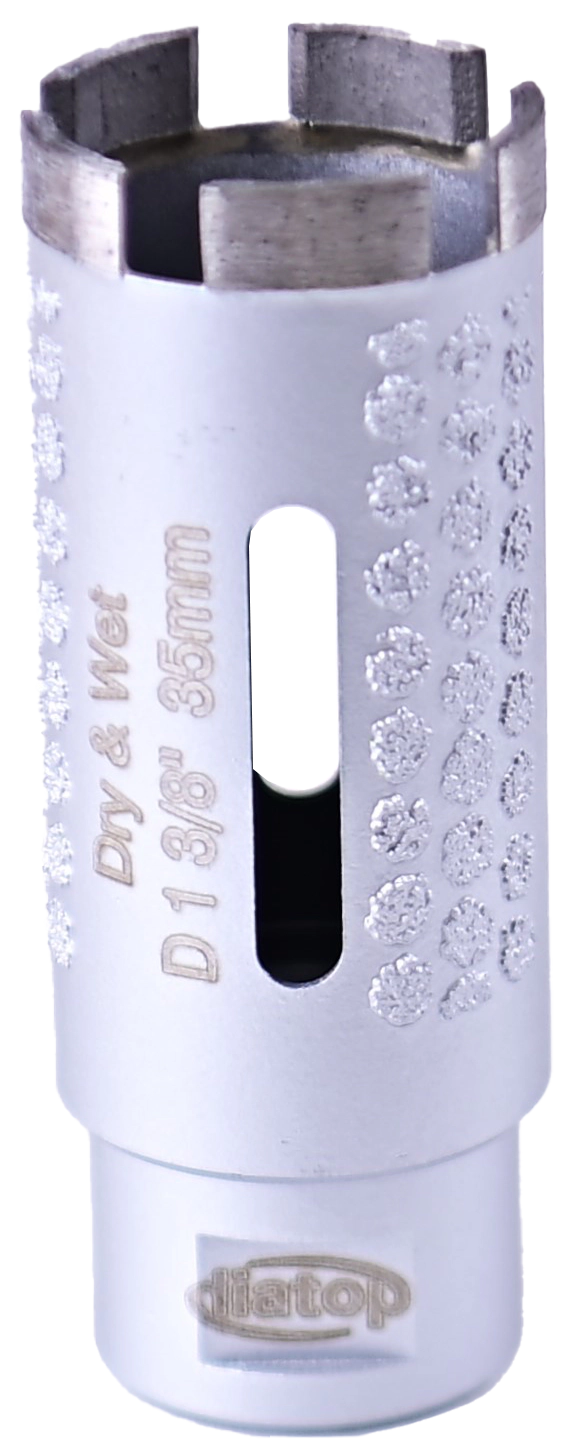
Professional Dry Core Drill Bit for Porcelain Drilling
Porcelain drilling requires a core bit capable of producing controlled holes in hard, brittle material while maintaining a thin cutting profile.
DIATOP Core Drill Bit for Porcelain is designed specifically for dry drilling of porcelain.
The range is available from 3/4 inch to 2 inches in diameter, with thin segment thicknesses from 2.1 mm to 2.3 mm.
All listed specifications use a 7 mm segment height.
Type of Equipment: D / D / HG (Drill Press / Power Drill / Handheld Grinder)
Key Features
-
Suitable for drilling holes in porcelain.
-
Designed for dry drilling.
-
Thin cutting thickness.
-
7 mm segment height.
-
Available in multiple diameters.
Available Sizes
Item – Diameter inch / Diameter mm / Thickness mm / Height mm
-
PCS-20 – 3/4 inch / 20 mm / 2.1 mm / 7 mm
-
PCS-25 – 1 inch / 25 mm / 2.1 mm / 7 mm
-
PCS-28 – 1 1/8 inch / 28 mm / 2.1 mm / 7 mm
-
PCS-35 – 1 3/8 inch / 35 mm / 2.1 mm / 7 mm
-
PCS-40 – 1 5/8 inch / 40 mm / 2.1 mm / 7 mm
-
PCS-50 – 2 inch / 50 mm / 2.3 mm / 7 mm
Technical Notes
-
Drilling Type: Dry
-
Suitable material: Porcelain
-
Segment Height: 7 mm
-
Segment Thickness: 2.1 mm for 20–40 mm diameters
-
Segment Thickness: 2.3 mm for 50 mm diameter
Typical Applications
porcelain drilling, porcelain tile drilling, dry porcelain drilling, countertop hole drilling, porcelain slab fabrication, ceramic hole drilling, stone and tile fabrication
Q1. What core drill bit is recommended for drilling porcelain?
A. DIATOP Core Drill Bit for Porcelain is designed specifically for dry drilling of holes in porcelain.
Q2. What sizes are available for the Core Drill Bit for Porcelain?
A. The catalog lists diameters from 3/4 inch (20 mm) to 2 inches (50 mm).
Q3. What segment thickness and height are available?
A. The 20–40 mm sizes use a 2.1 mm thickness, while the 50 mm size uses a 2.3 mm thickness. All listed sizes have a 7 mm segment height.
For porcelain core drill bit selection guidelines, dry drilling conditions, and troubleshooting guidance, please visit the DIATOP Tech Notes section.
